Wednesday, 12 April 2017

What is that shiny red bus doing in the old medina?

It is a spring morning in Marrakech and I am sitting having my breakfast and reading my mails, while outside the usual maelstrom of traffic goes by in one continuous madness of honks and neighs and motorbike roars and bicycles and donkeys and taxis and old ALSA beige-coloured buses.

Yes, beige-coloured, in keeping with the taxis of Marrakech - if you go to the blue-and-white town of Essaouira, the taxis are blue and white, if you go to white imperial Rabat, the taxis are white - and so on and so on, one gets the picture and all is colour-coded and matching and soothing and as it should be.

The bus, with beige taxi reflected in its windows
But this morning for some reason I look up and there through the door to that crazy outside world I see a very new and very modern and very shiny RED bus. It does not look right at all.

It makes me a little sad about my beloved Marrakech. 'They' have already wrecked the old Mellah area, turning it into a vast open square with a very modern traffic system and neat, sanitised shops running around the edges. There are other developments afoot all over the medina. What will it become?

I step outside into the street to take in the enormity of this new monstrosity. It is a 'bendy' bus, with a rubberised concertina-like arrangement in the middle to help its extra length to bend around roundabouts and difficult turns. They tried these out in London and they didn't work amidst all that traffic. I am not sure how it will bend here around horses and caleches, and donkeys and carts and thousands upon thousands of motorbikes with families on top. They will all be stopped, I think sadly.

But as I watch I see that the normal world of Marrakech begin to pass by regardless ... and all the elements of this world are just the same and they take absolutely no notice at all of the shiny monster. It is just as if it isn't there. First comes a man rushing by with two large wheat sacks on his shoulders. Then some ponies tugging on a caleche. Then motorbikes scream by. And the red bus just sits there. Maybe it is more frightened of the rest of the traffic than the rest of the traffic is of it!

For it seems that the old Marrakech always re-asserts itself - after all, it has been assaulted by tourism since the Fifties ... and still so much is just the same. Enter the souks and you enter a world you are unlikely to see anywhere else in the world (especially now that the souks of Syria have been destroyed). Oh there is Fez of course - but Fez is ALL souks. Fez has nothing of the mad mixture of Marrakech ... and that madness is what makes Marrakech and, it seems, it will always do so. Incha'allah.


Thursday, 11 August 2016

Sage tea in the Marrakech furnace of summer

The temperature was 44 degrees in Marrakech today and although I had bought a hat I was feeling the heat somewhat as I passed a group of men sitting on the ground and happily drinking glasses of tea. 

'Le chaleur, le chaleur (the heat, the heat' , I commented. 

Immediately one of them offered me a little glass of his tea! And it was mercifully NOT the usual mint tea, but 'atay ble selmia' - tea with sage leaves. A few sips of this has a fantastic cooling effect: I felt much better and I was very grateful and told them - in my limited moroccan arabic - that they were lovely people and that the tea had helped me considerably with my heat problems. 


A complicated conversation then ensued, involving a lot of advice about how good tea was for the santé and so on. 


It went on and on and I was getting a bit lost as my Arabic vocabulary failed me. So the main man resorted to a lot of gesticulating, with some help from his friends.

 ... and finally I got it. They were pointing to a drinking place in the square behind me and they were emphasising the benefits of tea as opposed to, erm, things like WINE. 

I began to feel even more hot and bothered than I had felt before the tea: I fear these men have seen me entering that very same dark place of an evening, on many an occasion ...


Thursday, 18 February 2016

Marrakech marathon 2016 - a riot of colour

I came to Marrakech full of anxiety about running the half marathon. My glutes, hams and knees had been giving me hell during the training, and lately even my toes were playing up.  Combine this with an irritation in the eyes and a persistent mouth ulcer, and you have a very sorry me.

The day I arrived I stupidly made it all worse by going out on a run and deciding to have a race with a caleche (horse-drawn carriage): I went too fast and so the next day my hams were worse than ever.
But Marrakech is really the place to sort all these things out. I went to the pharmacy about my mouth and they gave me a very homeopathic-looking spray containing bee pollen and cloves and cinnamon and eucalyptus. I told them about my aching legs and said should I go for a cream or a massage. A massage the two men said without hesitation.

In Morocco massages are everywhere. You can go to a hammam (public bath place) for the complete treatment or you can go to a centre for ´remise en forme´ (putting you back into shape).

As I said, hammams are all over the place in Morocco – all Moroccans pay them a visit at least once a week and I am sure that is why they have such fantastic skin and hair. Treatment consists of steaming first in a sauna, then being scrubbed and exfoliated (could not quite believe the amount of skin coming off my legs the first time I went) and washed with chunky bars of olive oil soap. The finale and the best part is the massage: lying on a stone slab, bit by bit your body is dealt with in a series of wonderful strokes and pummellings, using a combination of sweet-smelling oils (rose and argan seem to be predominant). You come out feeling 25 years younger.

This time, however, I decided I needed some putting back into shape, so went to have my legs attended to by Leila: she told me they were too hard and I did not leave until she had completed the job of softening them up.  It was so wonderfully relaxing I almost fell asleep on the table.
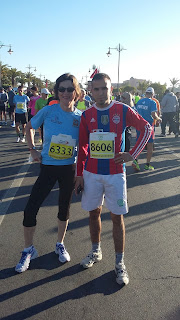
The morning of the marathon loomed and I was up bright and early and having my hot chocolate when the next crisis occurred.  Aziz, who was coming with me to the 9.15 start, rang at 8 and said the race was starting in 15 minutes! Aaaargh, I threw down my croissant and RAN out the door, past the Koutoubia and through the park to Bab Jdid (the New Gate) where I found him waiting with Hicham, his friend who was running and who confirmed that I was right and the race was starting at 9.15 after all.

(Hicham is young and fit and last year ran the race in 1 hour 35 minutes. This year he knew he had to equal that time, because his shift in a restaurant was to begin at 11!)

The start, on the Avenue de la Menara, was an impressive sight. This year there were over 10,000 runners, seemingly from every nation under the sun. Huge silky red Moroccan flags unfurled in the crowd, while drummers dressed in the green and red of the flag thundered away, stirring the crowd of dancers, stretchers and chatterers. I was surrounded by Arabic, French and Italian commentaries as people bent and jumped and generally tried out their muscles in every way.

The mass moved slowly over the line as the start gun went off at 9.15 and we headed down a leafy avenue through Hivernage (the hotel area) into Gueliz, the ´nouvelle ville´, turning away from the huge new railway station to plunge down a route of back streets which finally emerged into the olive groves of the Menara Gardens.

The Marrakech marathon really has to be one of the most stunning marathon routes in the entire world. After we left the Menara´s olive groves, we ran down the main airport road (traffic blocked to allow our progress – I was wondering about people missing flights!) and then turned right to face the sun, with the pink city walls on our left and the towering snow-capped peaks of the Atlas mountains ahead. The sun in my face felt good at that point (too early to be hot) and helped pass a good 5k in this direction before we turned again to run in some welcome shade past yet more olive and orange groves, this time the Agdal Gardens.

Another 2k and this time the turn was to the left, and now we had the sun behind us, bleached city walls on the left and vast stretches of desert on the right – a real sense of northern Africa.

Every so often there would be pockets of people cheering and clapping – ´bonne courage madame´, some said kindly to me. Happy kids held out their hands for a high five – having fun with them like this gave me bursts of renewed energy and off I would go again.

There were thousands ahead of me of course, so every 5 km or so I came across a section of the road both soaked and covered in orange peel … and then a little further on there would be a rainbow of sponges littering my way – a bit of a slithery hazard, but you need your water and the sugar-fruit boost on runs like this.

We were back into the city for the last punishing 5 km or so, and this really tested my reserves. It also tested the patience of the traffic being held back by policemen – at one point a bike just in front of me tried to break through, but a furious gendarme had got to him before he had any chance of getting to me. Those bikes revved and roared in frustration, but the police (and army, actually) were having none of it.

A final lung-choking sprint to the line, and then there really was a bit of Moroccan (or French, as race organized by French) chaos, as after medals were handed out we were all squashed into one long narrow corridor on the road in the sun, queueing, shoving, pushing, to get out past the barriers and be given a precious bottle of water. People unable to wait – a woman by me nearly fainted – were screaming out ´lma! lma!´(water) and race officials were torn between compassion and duty...

I was too dazed to be able to focus on anything. I had crossed the line after about 2 hours (still awaiting official results) and could scarcely believe that the legs had held up. I copied a ring of runners doing stretch exercises and then sat on the pavement and felt hot and hungry and wished I had some money to buy a sesame bun from the man offering them to me. He can´t have done much business as most runners were like me and had nothing with them (except their phones of course!).

And Hicham? Again he achieved 1 hour 35, which meant he finished the race at 10.50 and ran over to the restaurant where he works to start at 11. A 22-km run before a 12-hour working day: that is what I call impressive.

I walked slowly back home wearing my T-shirt and medal, and street sellers and taxi drivers and people everywhere called out: ´Felicitations six thousand three hundred and thirty three!´ (6333, my number, but everyone spelt it out in full). They made me feel great. Would people in England have called out to me like that? I wonder.

En route to my favourite café, I stopped to look in a shop. Seeing my T-shirt, the shopkeeper asked if I had won. Not exactly I say. He asked to see my medal: ´oh it´s a gold one!´, he said, ´you are the winner! You must have won a lot of money!´

I explain sadly that apart from the medal I won walu (nothing). But no, he corrected me, ´you have won sport – vous avez gagné le sport – and with this you have won your health´.

Oh they are so good at making the most of a situation these Moroccans.

Wednesday, 18 November 2015

The policeman sandwich

The policeman sandwich

Now more than ever I get asked the question: “Is it safe to go to Morocco?”

I can´t of course pretend to be a security expert and offer complete 100% assurances that all is safe there. But as I am there a lot and I observe a lot, I can at least offer the following:

It was in January this year when I first noticed the appearance of the ´policeman sandwiches´ on the streets of Marrakech. This is what the locals call the security trio/triplet, which consists of one policeman flanked by two camouflaged soldiers carrying machine guns – and this is a trio which is repeated all over the city, and which strikes me as a clever way of subtly monitoring and ensuring the security situation.

You will note these trios standing outside banks, the bigger hotels and companies … and not far away from most tourist attractions, if not all of them. Also outside some of the bigger restaurants.
They are very subtle these trios and have clearly been told not to make themselves look too obvious. One morning I was photographing some beautifully carved trees down the far end of Boulevard Mohammed V, near a military barracks and near the French Institute. One moment I noticed one of these trios, the next they had disappeared behind a tree. They clearly do not want to be photographed.
But I have also seen tourists approach them and ask them who they are, what are they doing? Always smiling and courteous, and speaking in either a beautiful French (those Moroccans who learn French speak it exquisitely, with an enviable Gallic accent) or an English which is not so bad, they explain that they are there to keep the peace.

To keep the peace. And thus far so has Morocco remained. In peace. The king, a clever and thoughtful man, maintains the country in a peaceful state – of course it is not perfect, but you will find that the overwhelming majority of Moroccans you meet love their king and believe devoutly in their faith. In the past, the King has even arranged to send some of the Moroccan imams, famed for their moderation, to countries like Mauritania and Mali to help them to preach tolerance. And in September it was announced that French imams are to be sent for training in Morocco as part of a new programme that aims to promote “an Islam with the right balance” that conforms to “values of openness and tolerance” (I have no update as to whether this has begun yet).


Furthermore, this wise King, like the Queen in England, is head of the faith! So who would rise up against him in the name of Islam? 

Friday, 2 October 2015

The difference between a bus in Marrakech and a bus in London

I leave my friends in Marrakech a little late and see the airport bus at the stop ahead of me, 100 metres down the road. Aaaargh, I have the time wrong again. I start running, dragging suitcase behind, and yelling 'Bilati, bilati!' (Wait!)

As I draw near, the bus is still there, but then it pulls out into the road - the driver hasn't noticed me. But plenty of other people have ... a taxi, of all things, starts honking loudly at the bus, a man shouts at the driver, and then people on the pavement alert the attention of a bus official. 'Aeroport madame?' he says, and 'Yes!' I pant and he ... blows his whistle and runs at the bus and bangs on the back of it.

And the bus, which by now has entered into a lane of manic traffic, screeches to a halt and unbelievably starts to turn back into the stop, while all the while preventing any other traffic behind it from moving forward. He comes back to the side of the road, and opens the door, and I hurl myself inside with a 'chukran bisef' (thank you very much) and 'smahali smahali' (sorry). The driver says nothing and just stares at me. 'I'm sorry', I repeat. 'Are you angry?'

He looks again and then ... bursts out laughing, as do the other passengers, all Moroccans. They grin at me as the bus shoots away and I stumble along with my unwieldy suitcase. It's all sooo friendly.
................................................................................................................................................................

I arrive back at Gatwick airport at 11.40pm and there is the usual ridiculous queue for customs, which takes 40 minutes to get through and means I miss any chance of taking a train all the way home. I have to get out at East Croydon and look for the dreaded night bus. There are two stops for the same number bus, one with the destination South Croydon and one West Croydon. I want to go to West Norwood which lies roughly north of both of those places, so I am none the wiser.

I am waiting by one when I see the bus draw up at the other. I RUN back to it and ask the driver - a snippy-faced woman - if she is going to West Norwood? 'Yes obviously', she says. 'Can't you see it says West Croydon up there?'

I explain that I don't have a clear geographical idea of how West and South Croydon relate to West Norwood and she snaps that there is a list and a timetable on the post. I say I saw West Norwood on that at the other stop and she looks witheringly at me and says you have to look at the direction.

'Well it's very late and I'm tired', I say, 'but can you wait while I run and get my luggage from the other stop?' There is a deep impatient sigh. 'I have to keep to the timetable', she says.

So I run like mad for the case and run back ... and enter a bus full of cold stony-faced people: never mind about helping me home at 1.20 in the morning, they have been held up ...

I tell you, give me Marrakech any day.

Tuesday, 8 September 2015

Dinner with Muhammad's family

Muhammed, the loom worker, is my friend and one of the smiliest people I have ever met. He has a wonderful smile, lighting up his face and lighting up my spirit. He is also one of the most Muslim of Moroccans, climbing out from under the loom to don his djellaba and rush off to the nearby mosque at every call to prayer. He also delicately asked one day if we could cut the music off the laptops – the ‘boys’ in the shop were showing me some local singers – as there were special sung prayers going on at the mosque, all the while apologizing profusely.

He sits there working that loom all day, from 9 to about 6, with a short break for lunch – sitting on the floor of the shop at the back – and even shorter breaks for the mosque runs. One whole day’s work results in one shawl or scarf (though they are quite large) – and he has to concentrate quite hard on the fine threads, although is often looking up and flashing me one of his smiles to reassure me.

We communicate largely by smiles, as Muhammed has no English or French and until recently my Arabic was limited to greetings and asking how much? (so I got quite good with the numbers too).

I have another friend in the shop – Mustafa – who speaks very good English, and so he generally does the translating when Muhammed and I want to get on to anything more complex than enquiring after each other’s health.

It was quite of a challenge, then, when Muhammed asked me to his house for dinner, to meet his wife and children. He told me (through Mustafa) that his home was about 3km away and that we could walk there, and we agree to go at 6 that day (like all Moroccans, Muhammad has a fancy mobile, so I presume he phoned to warn his wife).

Muhammad has a bicycle and the ‘walk’ home turns out to be a 45-minute canter, charging across busy roads and weaving through people and donkeys and carts and bikes as the sun goes down. We slow down when we get to an area where the streets are just teeming with activity, every shop a fascinating display for me, but no time to stop and look …

Finally we are heading down an alley and ‘dar’ (home) is at the bottom. Muhammad calls up the dark stairs ‘Maryam!’ and a young girl – his daughter – comes down and lights me up the stairs with the help of a mobile … for Muhammad has once again rushed off to the mosque.

Upstairs I find one room the size of an average lounge, on one side of which there is a low coffee-style table, two sofas and a big TV, and on the other a large double bed: it is clear the whole family live and sleep in this room. Yusuf, the six-year-old, bounces about cheekily on the bed and Miriam introduces me to her mother Leila – at least I think she does cos Miriam doesn’t speak French or English either (she IS only 9).

Leila brings in a tray of mint tea: we are waiting for Muhammad’s return and our lack of a common language is trying. We focus on the tea and sugar – I make big faces about how disgusting tea is without sugar as the men in the shop have started this, and we all laugh. Maryam fetches her French homework book and I try to help, but someone has already filled in the answers and they are all wrong!

Out goes Leila again and I realise that there is a communal kitchen on the landing, where there are also washing facilities. She comes back with bowls of harira soup and plates of dates and Muhammad, at last. There is also bread to dip into the delicious harira, brimful of chickpeas and cumin and lentils (this is a vegetarian one).

This is dinner for the family, I realise, although Yusuf’s not having any – he´s too busy showing off his acrobatic displays on the bed.

Then I feel a need for the facilities. I say ‘toilette’ and know they will get it, but they all look alarmed. ‘Amara!’, says Leila, and then, as I make for the landing, ‘Amara!’ repeats Muhammad with more urgency. Then nine-year-old Maryam hands me a towel and I think ‘Amara’ must mean loo paper and that I need to use this, so I take it and make for the place. ‘Amaraaa’, squeals Maryam as I go to open the door ahead … and then I hear noises inside. Aaah, ‘amara’ means occupied!


Tuesday, 28 July 2015

Lake Lalla Takerkoust - or the Barraj


On a hot Ramadan Sunday, Marrakech really does become a little insufferable, so I decide to leave the pink walls behind and go visit a pretty reservoir lake I had read about.

The lake of Lalla Takerkoust lies some 35 km south of Marrakech, and so I go to where buses and ‘grande’ collective taxis line up for places in that direction. The drivers seem vague about buses, but grande taxis go they say. In Marrakech these taxis are all 1970s Mercedes – one of my favourite models – and all beige (in Rabat, in keeping with the buildings, they are all white and in Essaouira blue and white). They are also always stuffed to the gills: four in the back, three in the front.

‘Lalla Takerhoust?’ I enquire of one of these Mercedes drivers and am directed across the road to a petrol station, where a man stands by a slightly larger and newer vehicle. I ask him and he says ‘how many?’: apparently he will take a group of me for a sum about ten times as much as the regulars go for.

No, no, I insist, ‘makein fluss’ (I have no money): I am just me and I want to go with all the others like a regular.  Ok, ok, he shrugs, and so begins the usual attempt to collect others to go by shouting out loudly ‘Barraj, barraj!’. (The word for dam is ‘barrage’ in French.)

After a while, an old man with one remaining tooth, skull cap and a large sack of vegetables turns up and indicates he wants to go. But, that seems to be it … so, desperate to get there, I join in yelling out ‘Barraj, barraj’, from my standpoint in the shade by the petrol pumps with other drivers..

Eventually one more man turns up (not sure whether he is attracted by my Barraj call or the driver’s) and as we have now been here for about 40 minutes, I decide I might as well pay for two-thirds of the fare so that we can GO.

Off we set, windows all down to allow in as much hot air as possible and the driver puts some Berber music on the CD and we all clap and sway along to it. One Tooth particularly gets into the spirit of it all, as does – rather alarmingly – the driver, whose clapping means that the wheel is regularly unmanned.

Still we get to the town of Barraj (or Lalla Takerkoust) in one piece and my fellow passengers instantly disappear. Not much in this town apart from huge great barraj looming over everything – and now the driver tells me that the actual lake is another 6km further on. In 39 degrees of sultry heat the walk does not seem too tempting, so I accept his offer to take me there for a further fee ...

And the lake is a real treat. Despite being man-made – the Baraj was built by the French in the 1930s to provide Marrakech with water and electricity – it is a very pretty lake with lots of twists and curves and covey inlets. Easy paths to follow, either along the shores or up and down little hills with lovely views and shady trees – no wonder the Marrakshis all normally come out here for picnics on Sundays.

The French called the lake Cavagnac (something to do with Christians immured in a cave and plunged by God into a mystic sleep), but the locals ignored that and called it Lalla Takerkoust after the lady saint protector of the area, who is buried in the nearby town of Amizmiz.
Amizmiz is near the source of the lake, where the water is reputed to have therapeutic qualities: apparently the sick of Marrakech go there and cover their feet with breadcrumbs so that they will be nibbled by the water turtles.

But today there are no picnickers and no people with sore feet (apart from me). It was Ramadan after all, and so – apart from a few fishermen, some small groups of boy swimmers and a goatherd with his goats – I have the run of the place to myself.  I wander around contentedly, remembering the lake scenes from Hideous Kinky, which were definitely filmed here, and finally settle under a tree for a bit of a sleep.

The sleep does not last long as I am disturbed by the arrival of some boys on quad bikes – probably not one of the more soothing attractions at the lake. They are very well behaved BUT, well, they are noisy. And – much as I love the wilderness of my area – I do gaze longingly across the water at what looks like a restaurant from which some pedalos are lazily making their way across the water.

It is a hot sultry day, as I have already mentioned, and so I descend for a paddle and the coolish water is very welcome. I would dearly love a swim, but decide that this is Out of the Question as I a) do not have a costume and b) am the only female around. There IS some sort of a policeman making the rounds on a quieter kind of quad bike but still I decide that I will wait till the next time I come, when I will hire all of the man’s taxi and bring a group and a picnic.

From my paddling area I can see yet more trails for walking, and also a clearer view emerges of the Atlas mountain range, which would be stunning on a cooler, clearer day. Also I spot some other restaurant-type places and what looks like private beaches. But perhaps they are closed today as it is Ramadan.

The quads are long gone and so are the swimmers and so is my bottle of water. Now is time for the return journey. I set off on the road back to the town of Barraj and am there surprisingly quickly – it is probably more like 3 than 6 kilometres.

Hot work, though, that walk, scorching. So the sight of a white frothy river tumbling over boulders far down below the town is just too much to resist. I race down there and douse my head in the cool clear water, much cooler than the lake. The local youth seem unfazed by my presence – all is cool, cool, cool, and Allah Akhbar.

Back up in the town of Barraj I find that there IS a bus service to Marrakech after all. And the fare is 7 dirhams, about one tenth of what I paid to come out here. Taxi drivers – they are the same all over the world …

But hey, now I know all about the lake and am looking forward to bringing a picnic party in slightly cooler weather!